Origami Street Lamp
A multi-level urban lighting system inspired by the art of folding
Abstract
The Origami Street Lamp is a 3.5-metre urban lighting pole whose form is derived from the geometry of folded paper. Rather than treating the lamp post as a neutral support for a single light source, the project reimagines it as an integrated structure in which form, engineering and illumination emerge from the same gesture: the fold.
Design Rationale
Conventional street lighting relies on a single elevated source that directs light in one direction. This approach tends to produce uneven illumination at pedestrian level, higher glare and light pollution, and a greater number of poles to cover a given area, while contributing little to the identity of the public realm. The project asks whether a lamp post can operate as a layered lighting system and, at the same time, as a sculptural element that strengthens the character of its setting.
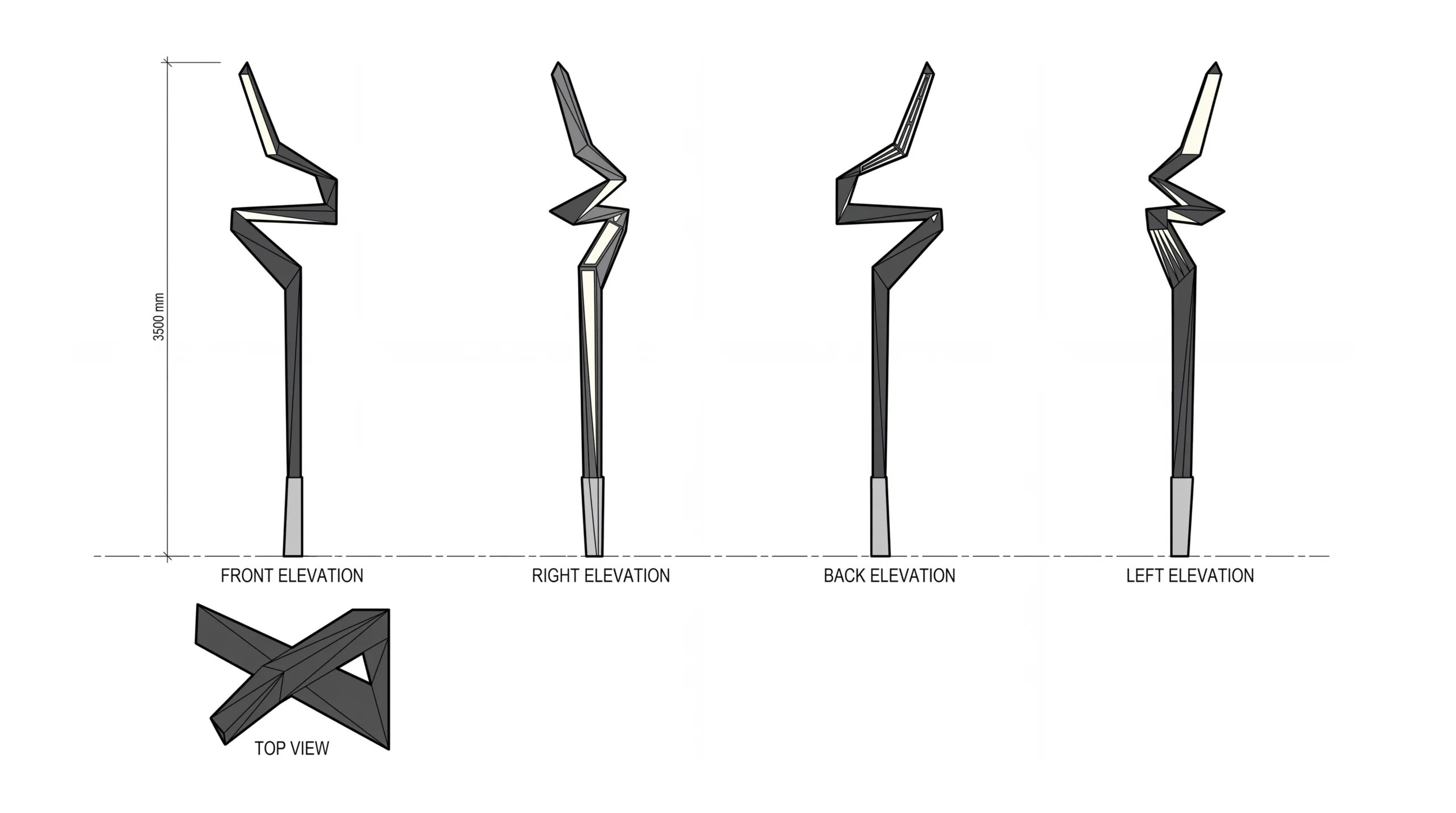
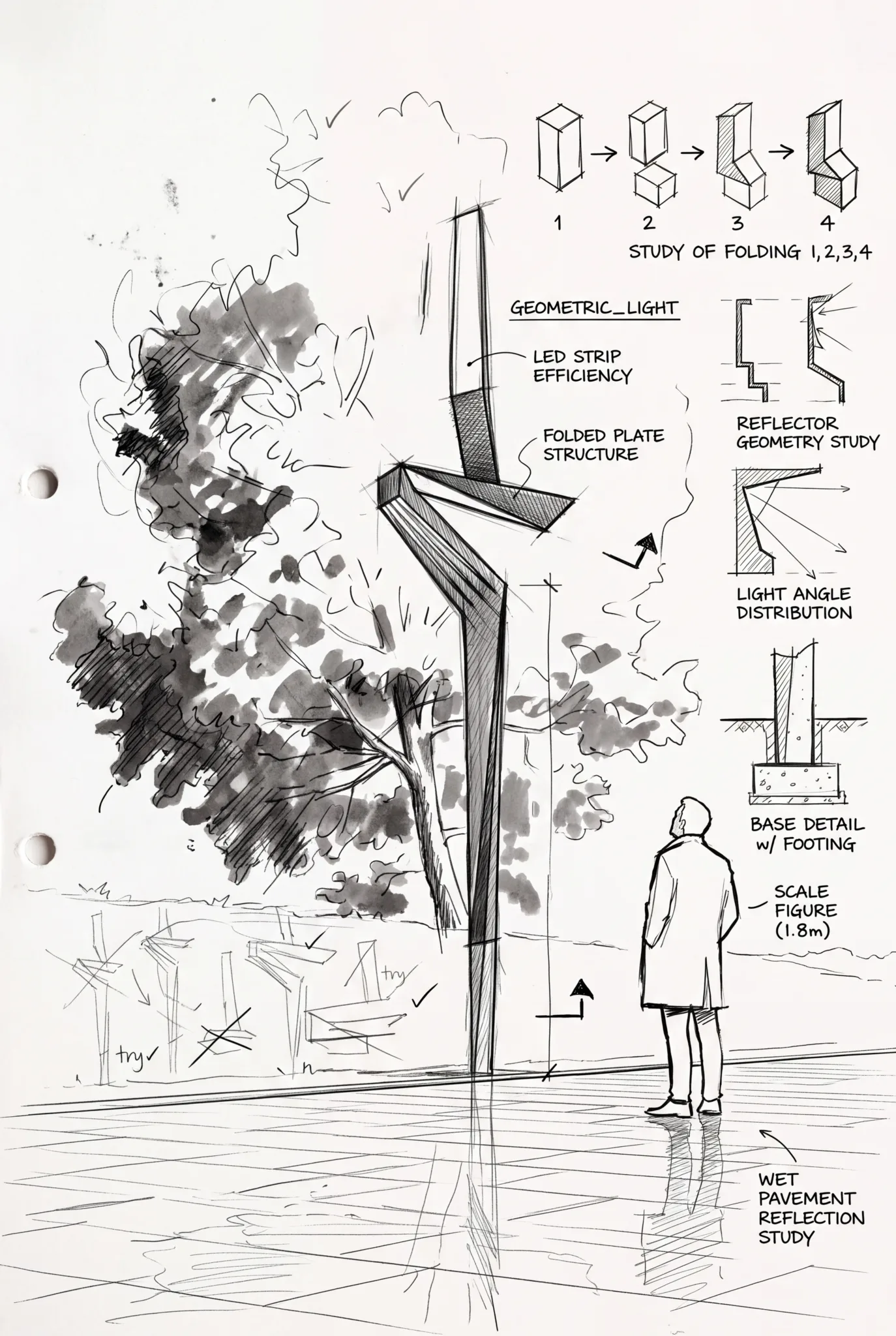
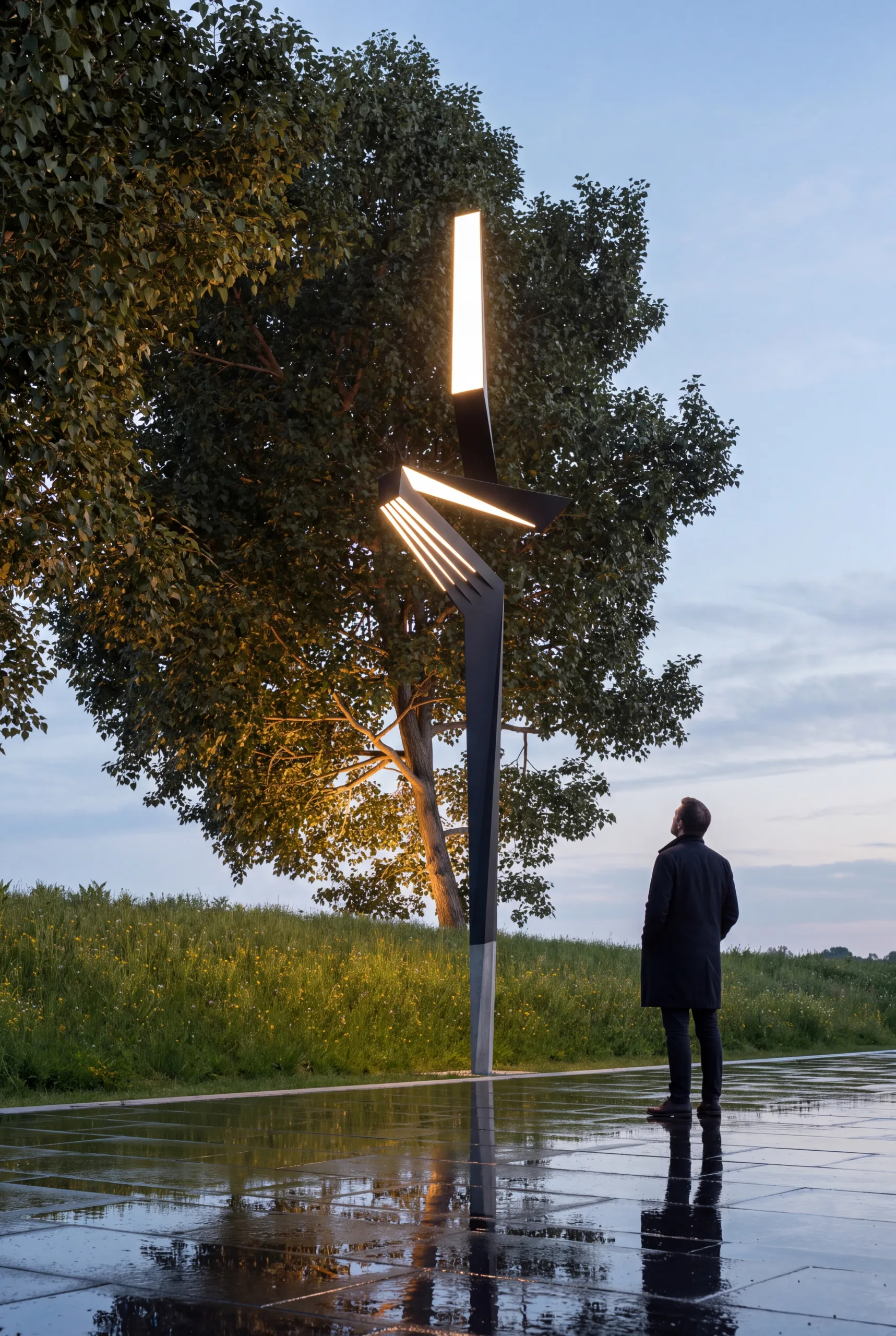
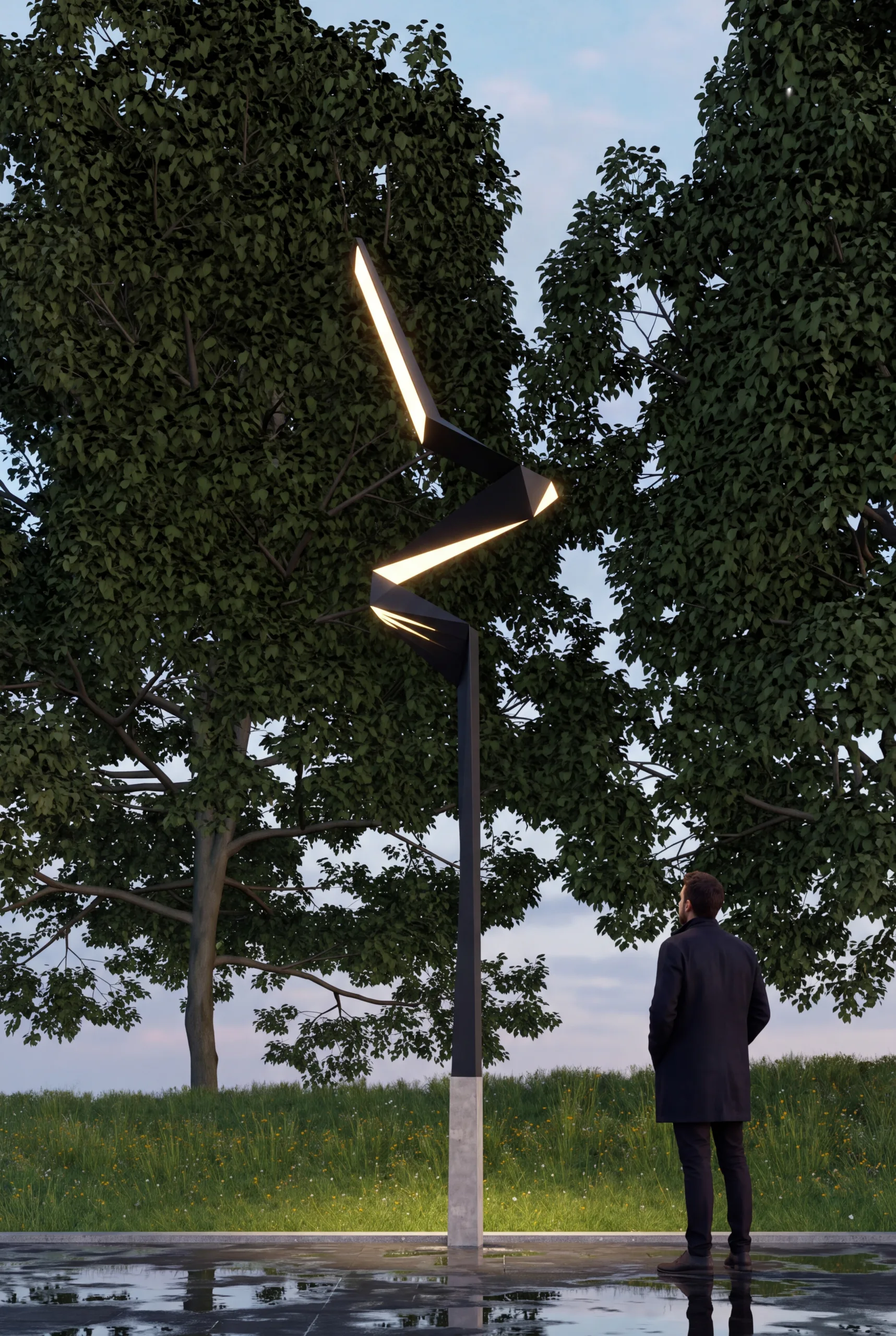
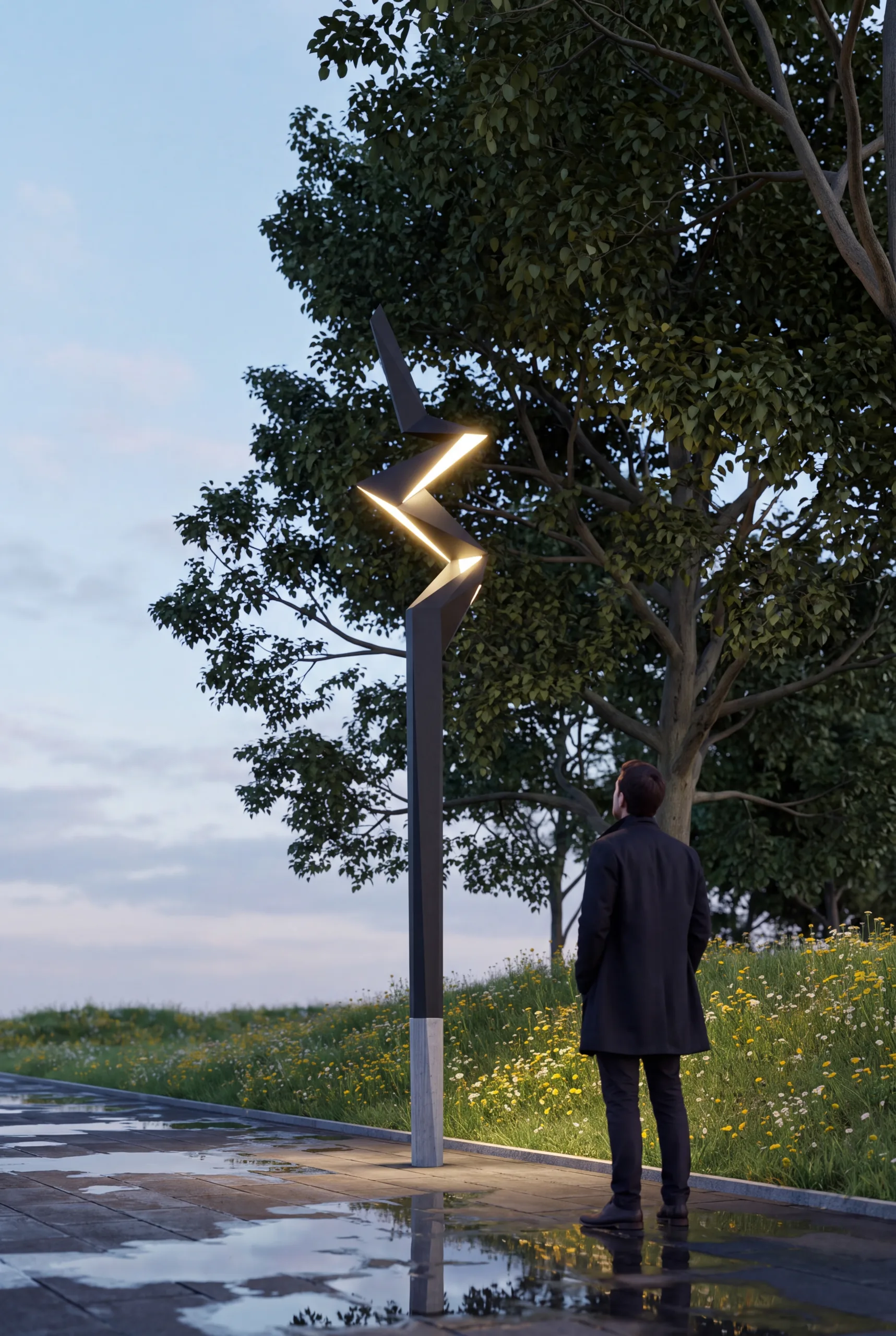
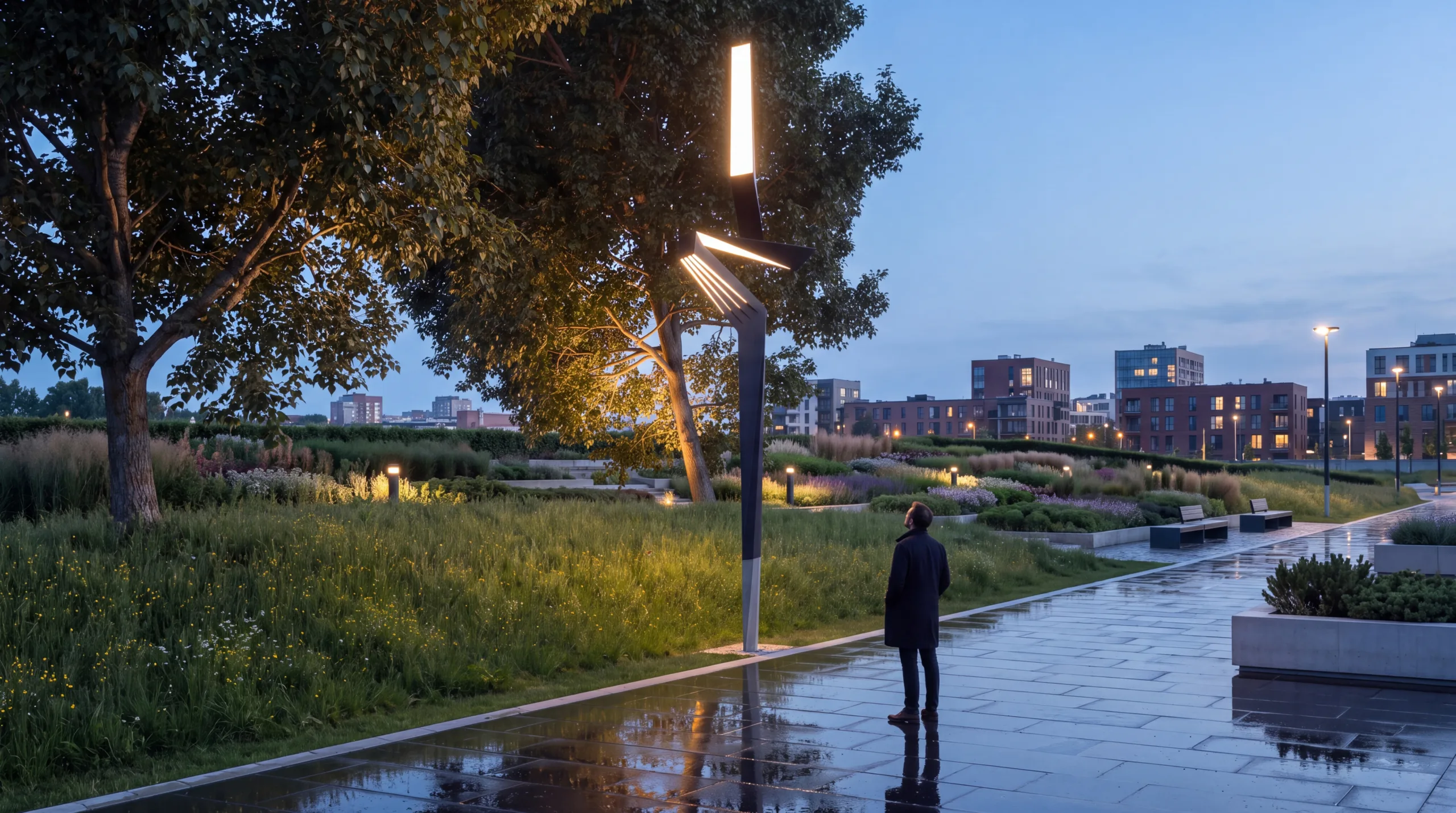
The answer begins with a simple principle: folding transforms a flat sheet into a rigid three-dimensional body without adding material. The pole is conceived as a single metal ribbon that rises from a straight, stable shaft and gradually breaks into a sequence of sharp, opposing folds, like a strip of paper caught at the moment of movement. In plan, the intersecting faces form a section close to an X, which gives the mass directional stiffness and produces surfaces of varying inclination. Each elevation reads as a different composition, so the object changes as the viewer moves around it. At 3.5 metres, the scale remains human and suits pathways, gardens and public squares. The design is documented through four elevations and a plan at 1:20.
Lighting Strategy
Every fold generates a new surface with its own angle and orientation, and each surface can host an independent linear light. The folds therefore become a load-bearing framework for illumination rather than a purely aesthetic device. Light is distributed across three heights. A continuous strip along the shaft sits at eye level, marking the path and supporting a sense of safety. Slender slits at the points of fracture throw light sideways and cast crisp shadows. At the crown, larger luminous panels provide soft general lighting directed outward and upward into the surrounding foliage. This gradation echoes the layered lighting used in interior design, ambient, task and accent, translated to the scale of open space.
The benefits follow directly from this distribution. One pole can do the work of several, reducing excavation, wiring, cost and visual clutter. Splitting the output across multiple low-intensity sources, each concealed behind a diffuser and a metal reveal, limits direct sight of the light source and therefore glare. Each group of luminaires can be dimmed independently according to the hours of use, and precise aiming of the light reduces spill, protecting the nocturnal life of plants, insects and birds.
Structure and Materials
The fold also performs structurally. Folded sections are considerably stiffer than flat plates of the same thickness, so the pole can be fabricated from relatively thin steel sheet while still resisting wind loads. The resulting hollow interior conceals cables and drivers entirely. The body is made of black powder-coated steel with a soft matt finish that absorbs light rather than reflecting it, sharpening the edges and keeping attention on the glow emerging from the folds. Junctions are precise and almost seamless. Within each luminous opening, warm-white LED strips are seated in an aluminium profile behind a curved, translucent diffuser that evens out the light and avoids hot spots. A pale grey concrete or metal base marks the transition between ground and dark steel, shielding the pole from moisture and impact.
Relationship to Context
The lamp sits alongside nature rather than competing with it. Its hard geometry contrasts with the organic forms of trees, yet it also reads as an abstracted metal branch rising from the ground, directing part of its light into the canopy. On wet paving, reflections extend the glow down to the level of the pedestrian, and at dusk the pole becomes a luminous marker that invites people to pause.
The Origami Street Lamp shows how a single gesture can unify three functions: it shapes the form, stiffens the structure and distributes the light. In doing so, it turns the street lamp from a lone source at the top of a pole into a sculptural, multi-level lighting system that gives contemporary identity to public space.