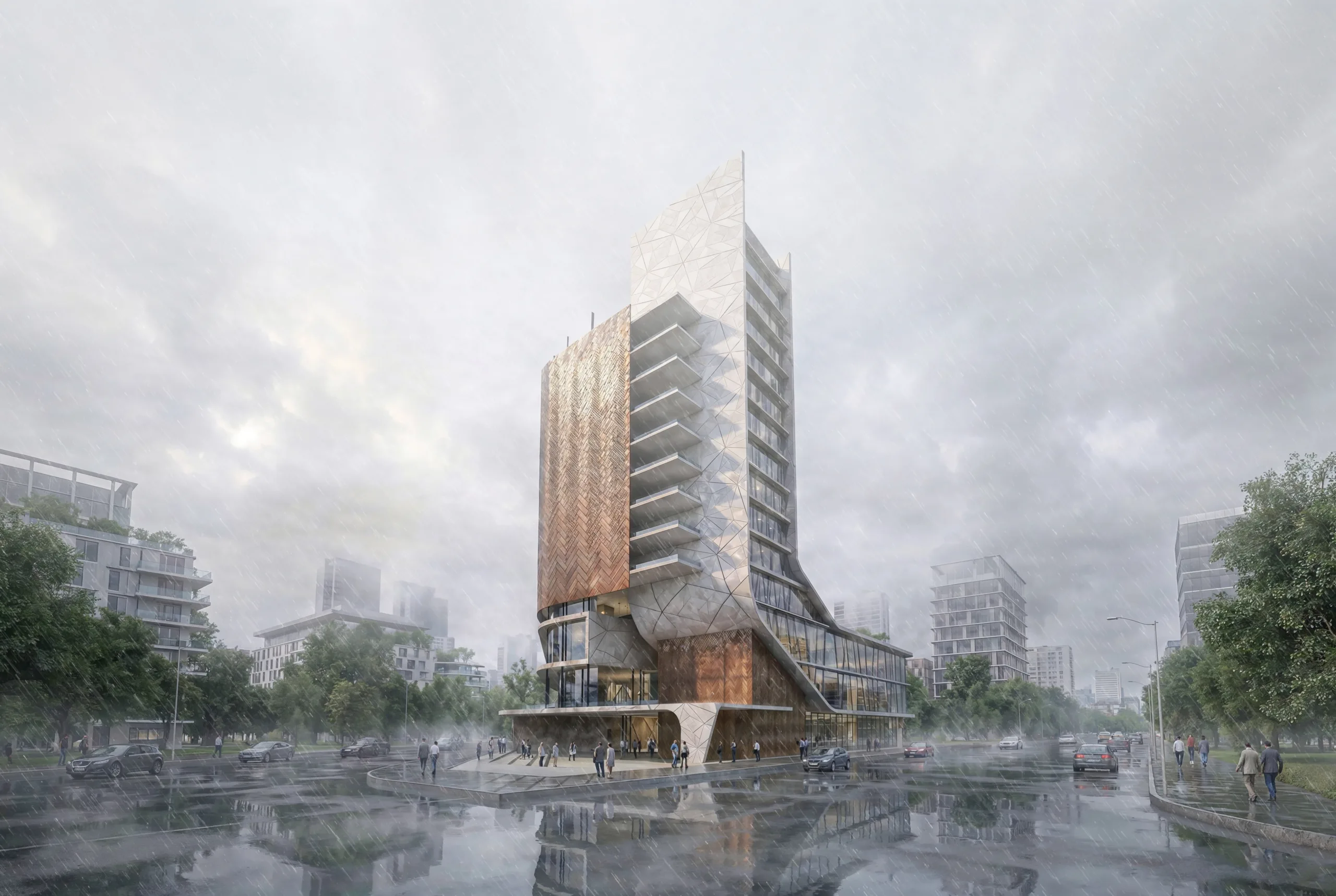
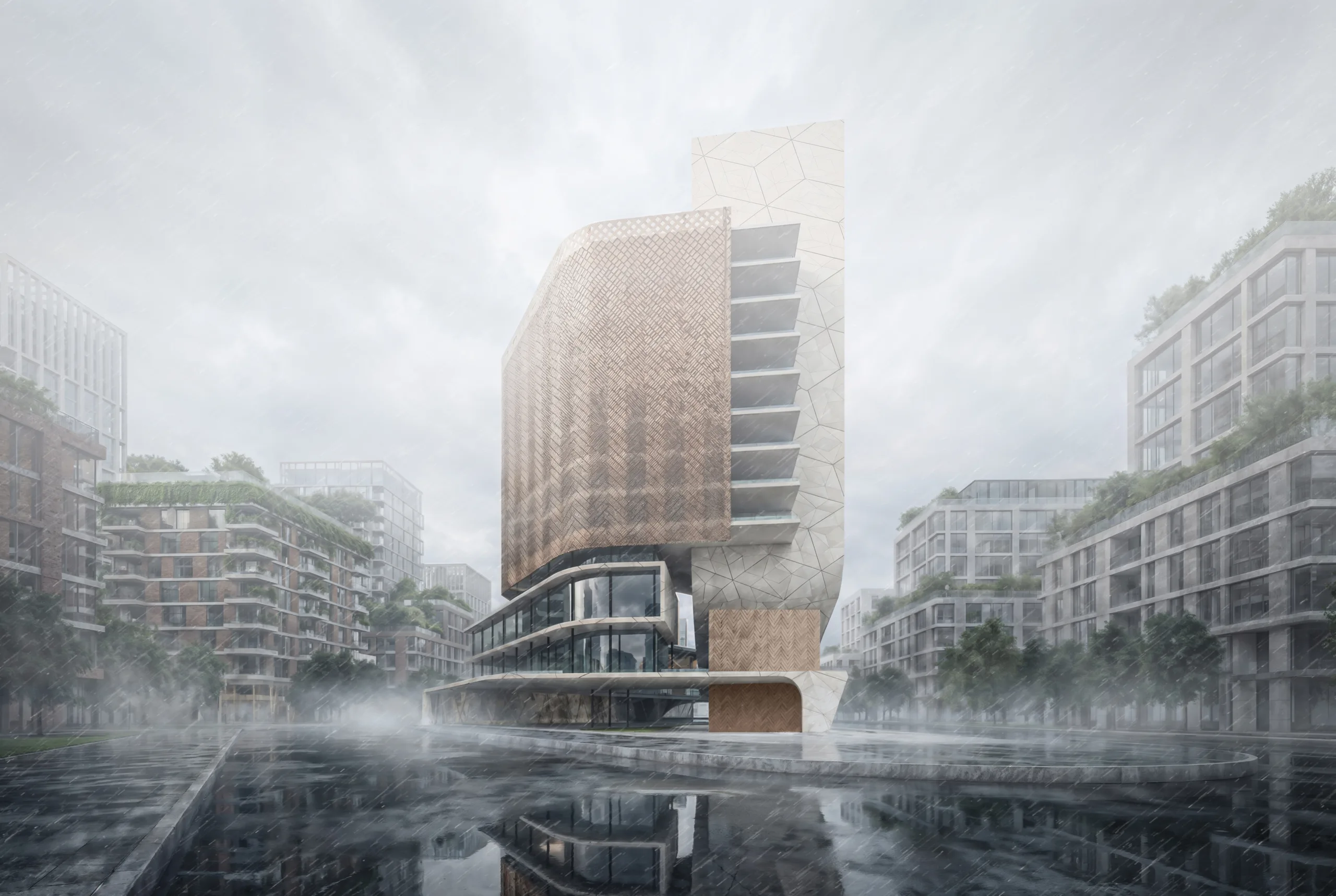
The project is located along a major urban axis in Lusaka and was conceived in response to the increasing demand for an administrative building accommodating office spaces. In addition to its primary function, the proposal integrates complementary commercial uses, including retail spaces, cafés, and restaurants, thereby reinforcing the mixed-use character of the project and its role as an active urban component.
The irregular geometry of the site, together with its position at the intersection of major roads, imposed specific design challenges that served as a catalyst for the architectural concept. Accordingly, the design introduces an open reception space that acts as an urban threshold preceding the building entrance, while simultaneously functioning as a semi-public space that serves the surrounding urban fabric and encourages social interaction.
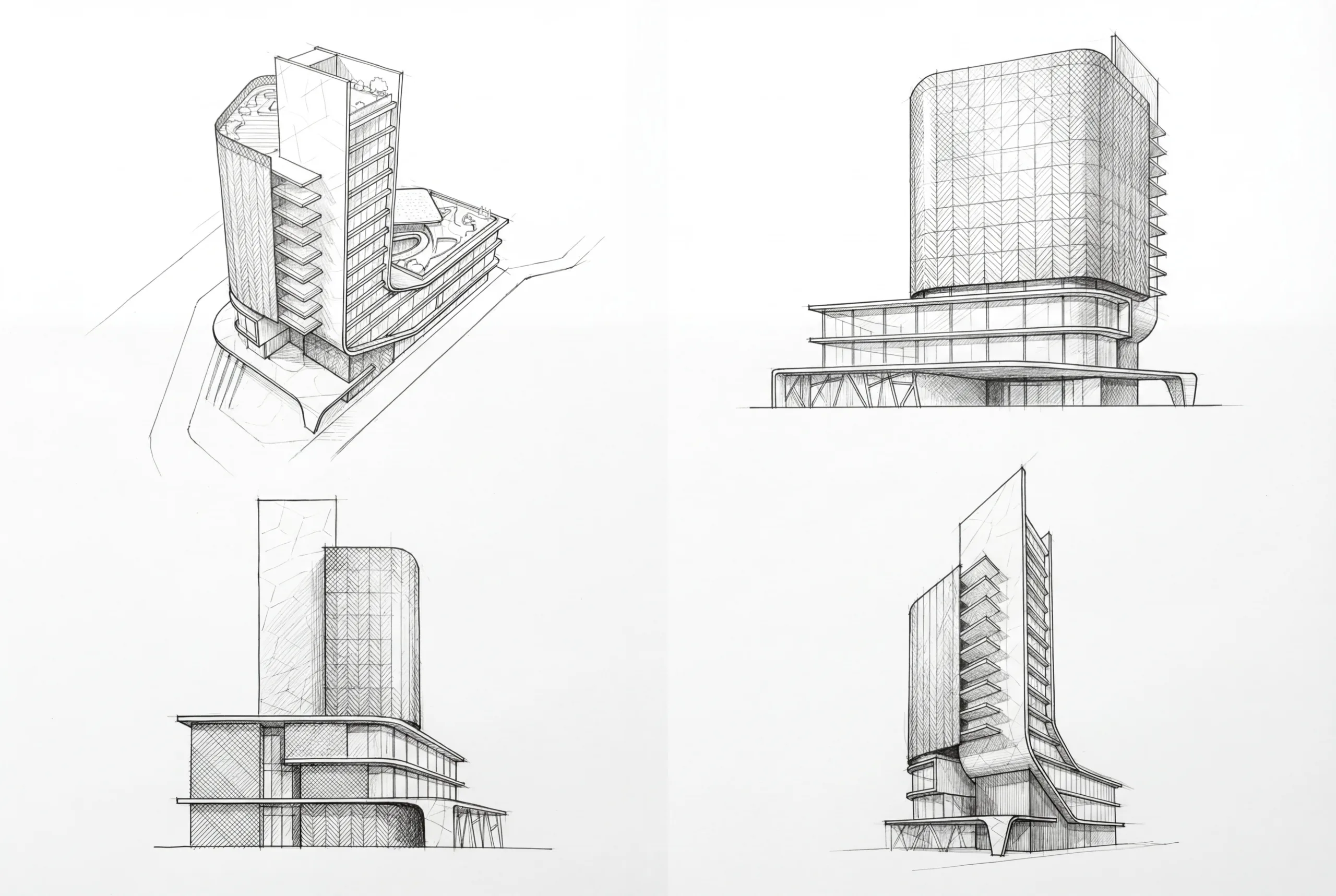
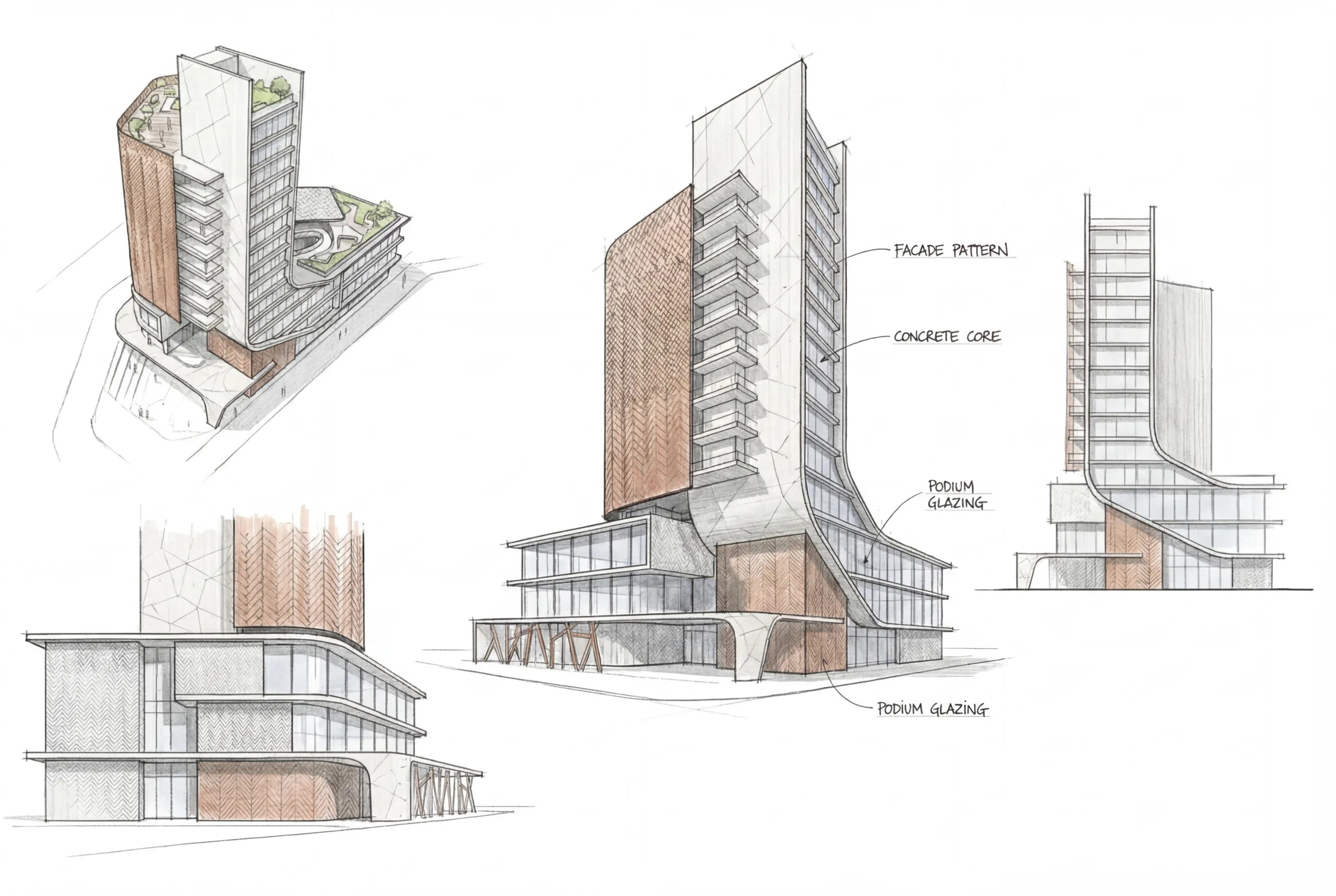
The horizontal projection of the project is conceived in harmony with the site conditions, with its lines and volumetric articulation derived directly from the characteristics of the land. The resulting architectural composition balances formal simplicity with spatial complexity, achieving clarity in structure while maintaining expressive depth.
Architectural functions are organized through a clear and rational hierarchy. Commercial activities are concentrated within the podium level, while office spaces are distributed vertically above, extending from the third to the fifteenth floor. This vertical stratification enhances functional efficiency and reinforces the hierarchical reading of uses.
Facade treatments respond to both climatic and contextual considerations. Extensive glazing dominates the northern elevation to maximize natural daylight and strengthen the visual relationship between interior and exterior spaces. In contrast, the eastern and southern elevations incorporate an architectural skin designed to regulate solar exposure and thermal gain, while simultaneously providing the building with a distinct architectural identity suited to the local climate of Lusaka.